Plasmino
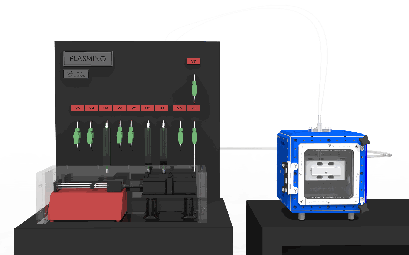
Custom DBD reactor
Our benchmark reactor for surface preparation, with no vacuum chamber. Designed and built by our experts in North America, adaptable to your process.
No vacuum
Atmospheric pressure
3 stages
Analysis, design, validation
20 years
Of plasma expertise
1 to 3 months
Lead time, standard reactor
- Reply within 48 h from an expert
- Trials in our laboratory in Québec City
- Quote with no commitment
One reactor, all your materials
Small flat surfaces
Built for R&D: your samples are treated the same way, run after run.
No vacuum, no compromise
No chamber, no pumping. It fits your current workflow, in the lab or on the line.
All your materials
Metals, polymers, glass, composites. It activates before printing, bonding or varnishing, and applies coatings too.
Support after delivery
Our team stays your direct contact, from commissioning to adjustments, for as long as you use it.
Three stages before delivery
Needs analysis
Material, throughput, environment: we frame your constraints before drawing a single part.
Design
Our experts size the reactor for your application, not for generic use.
Validation on your samples
Every prototype is tested on your parts before delivery. Results repeat from commissioning.
Designed for your process
What can be customised
- Reactor size
- Sample type
- Process gases
- Controllers
Frequently asked questions
What type of reactor do you offer?
Atmospheric pressure plasma reactors only. Size, sample type, gases and controllers can all be customised.
What lead time, from design to commissioning?
It depends on the customisation and is counted in months. We prefer a reactor that is right to a rushed delivery.
What support after delivery?
Every custom reactor has its own maintenance and support programme, for stable performance over its whole life.
How much does a custom reactor cost?
The price depends on the reactor size, the gases, the controllers and the R&D your process requires. We quote it on your case, with no commitment, after the free evaluation. Adding modules to an existing reactor costs less. What drives the price.
To compare, or to complete
 Precise zone
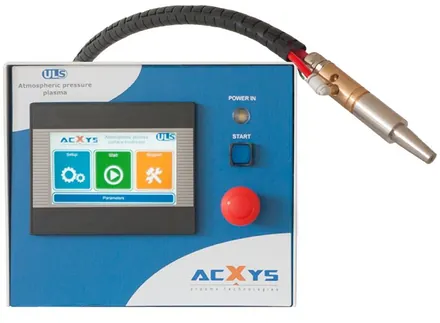
Compact torch
A nozzle that blows plasma straight onto the area to treat. The most common way to activate a precise zone on a 3D part.
See the page →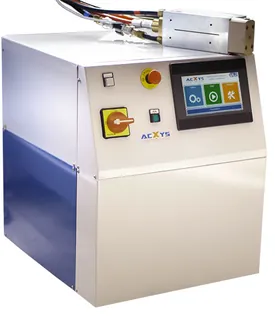 Wide web
Plasma curtain
A continuous curtain across a full width, for panels, sheets or webs on the move. Seven working widths from 60 to 500 mm.
View the page →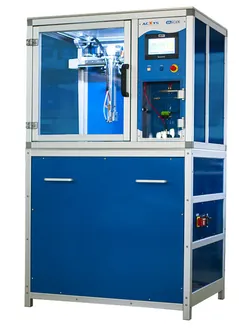 Automated station
Turnkey cell
An enclosed cell with a Cartesian robot, plasma source and safety interlocks. You program a path, the station replays it identically.
View the page →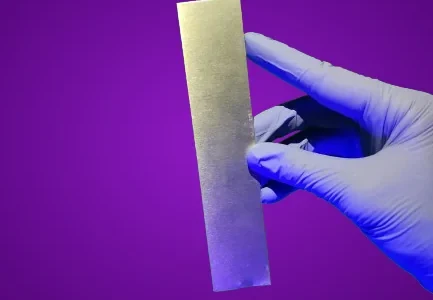 The complement
Test inks
A treatment you do not measure is not a process. The calibrated ink tells you in seconds whether the surface has passed the target threshold.
View the page →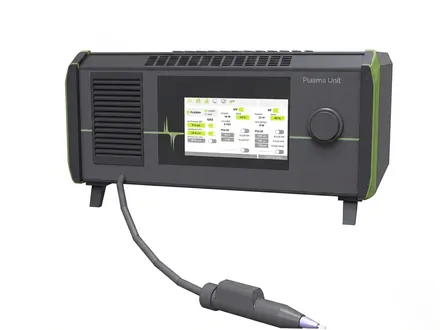 Millimetre precision
Precision torch
Cold plasma with a millimetre footprint, for small-area samples and sensitive substrates. It also accepts a precursor.
View the page →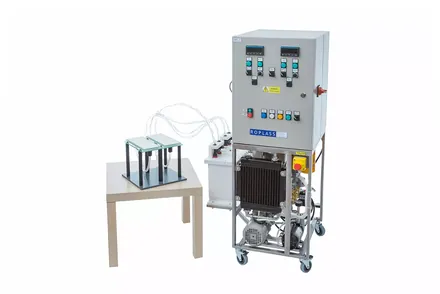 Whole surface
Surface source
A discharge spread across the whole electrode, treating flat parts and flexible films uniformly. No sweeping, so no over-treated band.
View the page →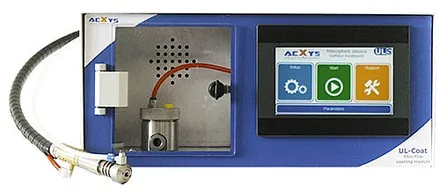 Film deposition
Deposition station
When activating is no longer enough: a 1 to 300 nm functional film deposited by atmospheric plasma, anti-corrosion or anti-scratch depending on the precursor.
View the page →As seen in